

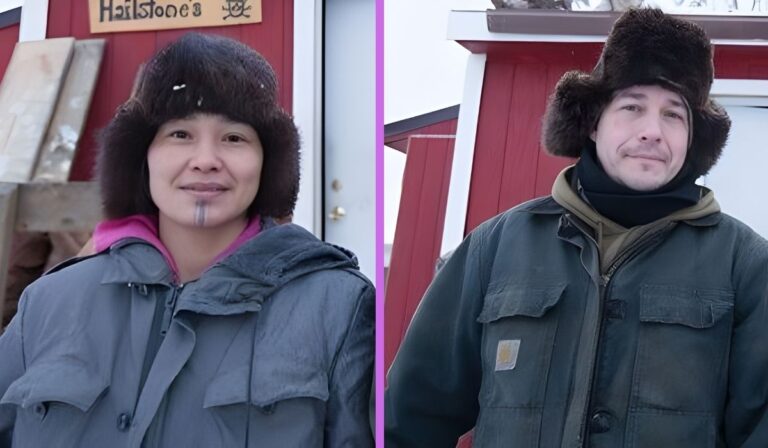
Imagine waking up in a place where the temperature drops to forty below zero, the nearest supermarket is a plane ride away, and everything your family eats must be hunted, fished, or gathered by hand. For most of us, that sounds like a nightmare. For Chip Hailstone, it is simply Tuesday.
For more than three decades, Chip Hailstone has lived deep in the Alaskan wilderness, raising a family of seven children along the icy banks of the Kobuk River in Noorvik, a tiny village about 19 miles north of the Arctic Circle. Millions of viewers came to know him through National Geographic’s Emmy-winning series Life Below Zero, where he appeared from the very first episode in 2013 until the show ended in 2025. But the cameras only captured a fraction of what it truly takes to survive in one of the harshest environments on Earth.
Chip Hailstone Quick Bio
| Detail | Information |
|---|---|
| Full Name | Edward V. “Chip” Hailstone |
| Date of Birth | March 8, 1969 |
| Age | 57 years old (as of 2026) |
| Birthplace | Kalispell, Montana, USA |
| Nationality | American |
| Current Residence | Noorvik, Alaska (Kobuk River, north of the Arctic Circle) |
| Moved to Alaska | 1988, at age 19 |
| Wife | Agnes Hailstone (married circa 1992) |
| Children | Seven — two sons (Douglas and Jon) and five daughters (Tinmiaq, Iriqtaq, Mary, Caroline, and Qutan) |
| Profession | Subsistence hunter, fisherman, trapper, and TV personality |
| Famous For | Life Below Zero on National Geographic (2013–2025) |
| Show’s Achievements | 23 seasons, 9 Primetime Emmy Awards |
| Lifestyle | 100% subsistence living off the Alaskan land |
| Known Skills | Hunting, fishing, trapping, tool-making, ice reading |
| Wife’s Heritage | Iñupiaq (Native Alaskan), born and raised in Noorvik |
| Status in 2026 | Still living the subsistence lifestyle in Noorvik |
Who Is Chip Hailstone? From Montana Boy to Arctic Legend
Before he became a household name, Chip Hailstone was just a young man from Kalispell, Montana, with a love for the outdoors. In 1988, at only 19 years old, he traveled to Alaska for what was supposed to be a short visit. He never went home.
The turning point came when he met Agnes, an Iñupiaq woman born and raised in Noorvik whose family’s connection to the land stretches back thousands of years. The two married around 1992 and built a life together on the Kobuk River, raising seven children in a community where survival depends on skill, patience, and teamwork.
When Life Below Zero premiered in May 2013, the Hailstones became instant fan favorites. Audiences were fascinated by a family that didn’t just talk about self-reliance — they lived it every single day. Even after the series wrapped in 2025, the family has continued their traditional lifestyle, proving their skills were never just for television.
So what exactly keeps this family alive in the unforgiving Arctic? Let’s break down the seven survival secrets.
Skill #1: Subsistence Hunting for Year-Round Food
In Noorvik, there is no butcher shop. If the Hailstones want meat, they must find it themselves — and Chip Hailstone has spent decades mastering the art of subsistence hunting.
Caribou is the family’s lifeline. Each year, massive herds migrate across the tundra near the Kobuk River, and timing is everything. Chip reads the land like a book, watching for tracks, droppings, and weather patterns that signal when the animals are moving. A successful caribou season can feed the family for months, while a missed migration can mean a long, hungry winter.
Beyond caribou, the family hunts moose, waterfowl, and seals, with each animal arriving in its own season. What makes their approach remarkable is efficiency: nothing goes to waste. Meat is eaten or preserved, hides become clothing and gear, and bones and antlers are turned into tools. For the Hailstones, hunting isn’t sport — it’s the grocery store, the clothing shop, and the hardware store rolled into one.
Skill #2: Fishing the Kobuk River in Every Season
If hunting is the family’s backbone, fishing is its heartbeat. The Kobuk River flows right past their home, delivering salmon, sheefish, and whitefish in astonishing numbers — if you know how to catch them.
In summer, the Hailstones set gillnets in the river’s channels, hauling in fish by the dozen. The catch is then split, dried on wooden racks, and smoked using techniques Agnes learned from her elders. This dried fish, known locally as “paniqtuq,” provides lightweight, protein-rich food that lasts through the darkest months.
Winter transforms the river into a sheet of ice several feet thick, but the fishing never stops. The family cuts holes through the frozen surface and jigs for sheefish, a prized Arctic species that can weigh over 20 pounds. Ice fishing in sub-zero temperatures demands patience and toughness — qualities the entire Hailstone family has in abundance.
Skill #3: Trapping and Fur Harvesting
Long before reality TV, trapping was how people earned a living in the Arctic, and Chip Hailstone keeps that tradition alive. During the winter months, he runs traplines targeting wolf, wolverine, fox, beaver, and muskrat.
These furs serve two critical purposes. First, they provide income — high-quality Arctic pelts remain valuable and help the family purchase fuel, ammunition, and supplies that can’t be made by hand. Second, they provide warmth. Agnes, a skilled traditional seamstress, transforms wolf and wolverine fur into parka ruffs, mittens, and boots that outperform anything sold in stores. Wolverine fur, in particular, is treasured in the Arctic because frost brushes off it easily, keeping faces free of ice at forty below.
Running a trapline also means traveling hundreds of miles by snowmachine through empty wilderness — a skill and a risk all its own.
Skill #4: Reading Weather and Ice Like a Map
Perhaps no skill is more important to survival in the Arctic than knowing when not to go. In Chip Hailstone’s world, a single misjudgment about ice thickness can be fatal.
Before crossing any frozen river or lake, Chip tests the ice, studies its color, and listens to how it responds under pressure. Clear blue ice is strong; gray or slushy ice is a warning. He watches cloud formations, wind shifts, and animal behavior to anticipate storms days before they arrive — knowledge that no weather app can replace in a region where forecasts often fail.
This wisdom is a blend of his own hard-won experience and traditional Iñupiaq knowledge passed through Agnes’s family. It is also the first lesson the couple drilled into their children: the wilderness forgives very few mistakes, so learn to read its warnings before you need them.
Skill #5: Crafting Tools, Weapons, and Gear by Hand
When your nearest hardware store is a bush-plane flight away, you learn to make and fix things yourself. Chip Hailstone is a talented craftsman known for making traditional knives, ulus (curved Iñupiaq blades), and tools from materials the land provides — including caribou antler, bone, and salvaged steel.
This self-reliance extends to everything the family owns. Boats get patched, snowmachines get rebuilt, nets get mended, and worn clothing gets repaired rather than replaced. Agnes complements Chip’s toolwork with her mastery of skin sewing, turning raw hides into waterproof boots and warm garments using techniques perfected over countless generations.
In the wilderness, the ability to create and repair is more than a money-saver — it’s life insurance. Broken equipment fifty miles from home is an emergency, and the Hailstones are always prepared to solve problems with their own two hands.
Skill #6: Navigating the Tundra Without Modern Comforts
The land around Noorvik is vast, flat, and deceptively featureless — a place where whiteout storms can erase the horizon in minutes. Yet Chip Hailstone moves through this landscape with remarkable confidence.
In summer, the family travels the winding Kobuk River by boat, reading currents, sandbars, and channels that shift every year. In winter, they cover enormous distances by snowmachine, navigating by memorized landmarks, river bends, wind-sculpted snowdrifts, and the position of dim Arctic light.
Chip also practices an old rule of northern travel: always be ready to survive the night outside. He carries emergency gear, knows how to build shelter fast, and never bets his life on a machine that could break down. It is this constant preparedness — hoping for the best while planning for the worst — that has kept him alive through 35+ years of Arctic travel.
Skill #7: Teaching the Next Generation
Ask Chip Hailstone about his greatest survival tool, and the answer isn’t a rifle or a knife — it’s family. From the time their children could walk, Chip and Agnes involved them in every part of subsistence life: checking nets, butchering caribou, sewing skins, and hauling water.
Their daughters, especially Tinmiaq and Iriqtaq, became skilled hunters in their own right, often featured on Life Below Zero taking down caribou and running boats solo. This is the Iñupiaq way: knowledge is not hoarded but handed down, ensuring the family — and the culture — survives long after any single member.
Today, with grandchildren now part of the household, a third generation is learning the same lessons on the same river. That unbroken chain of teaching may be the most powerful survival secret of all.
What Can We Learn From Chip Hailstone’s Wilderness Lifestyle?
Most of us will never skin a caribou or cross a frozen river at forty below. Still, the Hailstone way of life offers lessons for everyone: waste nothing, prepare before trouble arrives, respect nature’s power, learn skills instead of buying solutions, and invest in family above all. In a world of convenience and instant delivery, Chip Hailstone reminds us that true security comes from what you know and who stands beside you — not what you own.
Final Thoughts
Chip Hailstone’s story is more than a reality TV tale — it’s proof that the old ways of living with the land still work. Through subsistence hunting, year-round fishing, trapping, ice reading, hand craftsmanship, fearless navigation, and generational teaching, the Hailstone family has turned one of Earth’s harshest wildernesses into a home.
The cameras may have stopped rolling, but on the banks of the Kobuk River, the nets are still in the water, the traplines are still running, and the next generation is still learning. That is the real survival secret of Chip Hailstone.
FAQs About Chip Hailstone
1. Does Chip Hailstone still live in Alaska?
Yes. As of 2026, Chip Hailstone and his family still live in Noorvik, Alaska, continuing their subsistence lifestyle of hunting, fishing, and trapping along the Kobuk River.
2. Is Chip Hailstone still on Life Below Zero?
No. Life Below Zero ended in 2025 after 23 seasons when the production contract was not renewed. Chip appeared from the first episode to the last and confirmed the show’s conclusion himself on social media.
3. How did Chip Hailstone meet his wife Agnes?
Chip met Agnes in Kotzebue, Alaska, after arriving from Montana in 1988. They married around 1992 and settled in her home village of Noorvik, where they raised seven children.
4. Where is Noorvik, Alaska?
Noorvik is a small, remote Iñupiaq village on the Kobuk River in northwest Alaska, roughly 19 miles north of the Arctic Circle. It has no road access and is reachable mainly by plane, boat, or snowmachine.
5. Was Chip Hailstone ever in legal trouble?
Yes. Chip was convicted of perjury connected to a long-running legal dispute and served time before being released in 2019. He returned home to Noorvik and rejoined the show until its final season.
6. How many children does Chip Hailstone have?
Chip and Agnes raised seven children together: two sons, Douglas and Jon, from Agnes’s first marriage, and five daughters — Tinmiaq, Iriqtaq, Mary, Caroline, and Qutan.
Read more :- Minoo Rahbar Wiki 2026: Age, Wedding, Family And Full Life With Jackson Galaxy Revealed
